

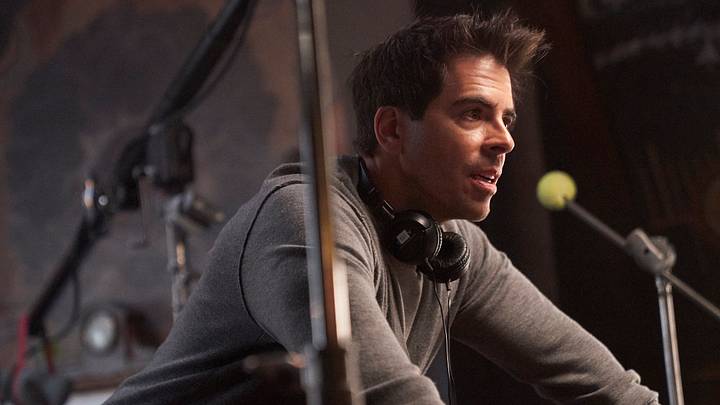
Veteran horror filmmaker Eli Roth’s latest feature film, Ice Cream Man, is releasing this weekend, and the writer-director himself would have audiences believe that this is a triumph of independent filmmaking on every level. After spending years within the studio system and struggling against things like studio notes and censorship (most notably on recent misfires like Thanksgiving and Borderlands), Roth decided to start his own media company, The Horror Section, to produce and distribute work directly to audiences, uninhibited by such things.
On the surface, this would seem to be a pretty cool move, one that Roth has said was directly inspired by the breakout success of the similarly unrated low-budget horror series, Terrifier. However, the release of Ice Cream Man has turned sour in a number of ways, in no small part because the film is absolutely awful, and the consensus of both critics and early audiences has reflected that. But further ruining things is the reveal that despite all that talk of independent integrity, Roth actually utilized extensive amounts of AI-generated footage throughout Ice Cream Man and lied about it.
If you have the good fortune of not having had Ice Cream Man inflicted upon you, I will surmise the basic gist of its deal as a foundation for further conversation. There is a malevolent ice cream man whose ice cream van plays creepy music and whose ice cream somehow sends black-and-white animated shorts to the digital devices (???) of anyone who consumes the ice cream. The combination of the ice cream and the animation drives the children insane and compels them to sporadically murder others. To anyone with a keen eye for detail, it becomes incredibly obvious early on that these brief animated sequences are AI slop. However, this didn’t stop Roth from initially denying any such claims, with a whole elaborate backstory to try and explain how they were actually created completely organically.
“I have an animation background and I drew it… I worked with an animation team and I wanted it to look and feel like — there’s an old Mickey Mouse cartoon where he goes to a haunted house and there’s brooms and dancing skeletons and this kind of flowing dancing stuff and the jittery style of the animation. So I drew the loop cycles and the styles. Then I had some animators help kind of make it a little more fluid, and I worked with an artist to give it a bit of an old-timey jittery feel. But I sat there and I drew out the frames that I wanted," Roth said in an interview regarding the creation of said animated bits initially.
However, upon the film’s release, it became obvious that this wasn’t entirely true, as Dark Half (an AI visual effects company) is credited for their work in the credits. In response to this new objective truth being brought to life, Roth has issued a new statement, saying, "I misspoke. AI was used in a very small portion of a few scenes in the film. It was an opportunity where technology and creativity came together to help bring my vision for the film to life.”
To put it frankly, this is just the most rancid sh-t imaginable. Roth clearly realized the optics of utilizing AI in the movie he was attempting to market as an ‘underdog independent horror film rebelling against the larger studio system’ was a bad look, so he deliberately obfuscated the truth and lied about it when pressed. It wasn’t until flat-out confirmation was revealed that he felt the need to begrudgingly admit to the use of AI.
There’s also something deeply funny about Roth having this whole story locked-and-loaded about the way the film was animated and how he was so influenced by the Mickey Mouse short whose title he can’t seem to remember (it’s a real difficult one: The Haunted House) when the reality is that he just used AI systems that had been trained on those very kinds of animation. That’s not influence, Mr. Roth; that’s theft, pure and simple.
Furthermore, Ice Cream Man’s use of AI stretches well beyond simply the animated bits. There are entire AI-generated shots, sets, and pieces of production design. So even in admitting the truth, Roth is actively downplaying the extent to which AI was utilized, hoping the whole thing blows over and the film can still turn a profit. All of this would be a devastating blow to the film’s integrity, even if Roth had been upfront about it from the start and if the film was good. But in reality, Roth has a worst-case scenario on his hands: the film is bad, he lied about the use of AI to try and keep it from audiences, and then the information still got out prior to release to the general public. It’s an outright PR disaster, and it’s one entirely of Roth’s own making.
 Add us as a preferred source on Google