

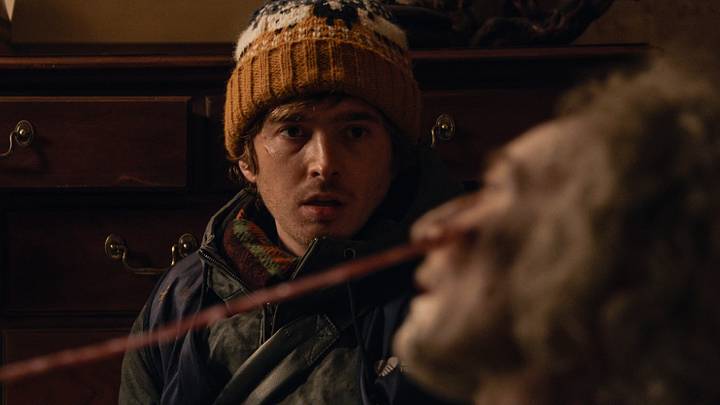
The marketing for the newly released Resident Evil film, written and directed by Weapons and Barbarian auteur Zach Cregger, played things very close to the vest. I mean, for crying out loud, the most widely utilized and circulated poster for the film (of Austin Abrams’ character Bryan about to hit a woman with his car in the snow) is entirely centered around an event that happens less than five minutes into the film. The trailers revealed precious little with regard to details about the film or its plot, instead primarily focusing on selling the film as a cinematic experience based on the franchise from a beloved filmmaker. And judging from early box office results and responses to the film, that approach more than paid off.
But one of the most notable beats in any of the film’s marketing was in its most recent trailer, which appeared to offer a glimpse, albeit brief, of a more narratively weighty scene. In the snippet of a scene in question, Paul Walter Hauser is seated in the front of a vehicle and appears to be talking to Bryan about the gravity of the situation they find themselves in, saying, "Everything that has happened in this town happened within twelve hours.” It’s the kind of line that works great in the trailer and does appear in the finished film as well. However, it’s in a very different context, and delightfully so, as it turns out the Resident Evil marketing lied to audiences in a brilliant way.
Exposition is a key component of storytelling, and yet it is so often handled so poorly. Audiences need to understand what is happening in a story in order to get invested in the stakes of it, but most films seem to resort to simply having a character speak directly to the audience as if they’re morons to accomplish this feat. This has become especially troublesome in recent years as it relates to streaming platforms and so-called ‘second screen entertainment,' in which characters practically narrating their actions, thoughts, and feelings for audiences who might not actually be paying attention at any given time.
But even prior to that development, horror has long been a tricky genre when it comes to exposition. While you undoubtedly want the audience to have an understanding of what’s happening, explaining too much can suck all of the mystique or suspense out of a given genre film. And yet, without fail, when it comes to supernatural or science-fiction horror, especially, there inevitably comes a point in the story where the main character needs to learn a way to defeat the antagonistic force and the audience needs to learn a bit about the backstory at play. And so to accomplish this, many films take the laziest route possible and simply have some new character show up to explain everything away with an exposition dump and a copious amount of hand-waving. Like, I really like Scott Derrickson as a filmmaker (Black Phone 2 is phenomenal), but one of my go-to bad examples for this is in Sinister, where Vincent D’Onofrio literally Zooms calls in to spout exposition for several minutes straight.
So when you see that snippet of a scene with Hauser in Resident Evil’s marketing, you probably feel safe assuming that’s precisely what the scene is going to be: a dull exposition dump to update you on stuff mid-movie and keep the plot moving. But in actuality, it is a giddy subversion of those exact kinds of scenes. The take of Hauser that is used in the trailer features him being very serious and matter-of-fact, but his actual performance in the film is full of scenery-chewing goofiness. In the film, it turns out he’s actually responsible for the virus’ outbreak thanks to an in-lab accident, and Cregger has the actor lean all the way into being as hopeless and helpless as possible. The scene does provide Bryan and the audience some essential information, but it does so while taking the piss out of these exact kinds of exposition dumps and having a tone of fun in the process.
These characters are unceremoniously dispatched of shortly thereafter in gruesome and hysterical fashion, and the whole thing is made all the more shocking and funny because the marketing led you to believe that this would be a very stock-standard and serious part of the film. Really great stuff, one of the most delightful surprises in a film dull of delightful surprises.
 Add us as a preferred source on Google