

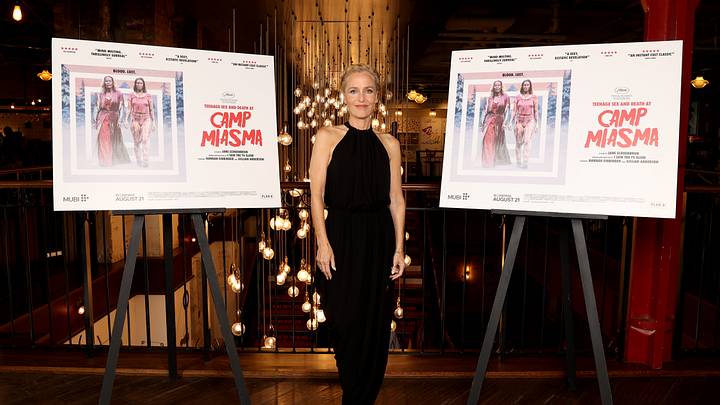
Jane Schoenbrun’s new film Teenage Sex and Death at Camp Miasma makes a meal out of equating the fictional film franchise within the movie’s narrative, “Camp Miasma,” to the real-world Friday the 13th franchise. While there are certainly other influences at play (many of which are outright named in the text of the film, such as Sleepaway Camp, The Burning, and Halloween), nearly everything about “Camp Miasma” is evocative of the Friday the 13th series, something that is explicitly highlighted during the film’s opening credits, which show viewers an entire cabin full of “Camp Miasma” paraphernalia that has one-for-one Friday the 13th equivalents.
The actual story of Teenage Sex and Death at Camp Miasma revolves around a fictional filmmaker (as played by Hannah Einbinder) attempting to break the story for a “Camp Miasma” reboot that she has been tasked with making by venturing out to the filming location of the original installment in the franchise, where that film’s ‘final girl’ actress (as played by Gillian Anderson) now lives. Schoenbrun's film is a many-splendored thing and an outright blast; I cannot recommend it enough. But one of the greatest and most joyous surprises of the film comes when it drops one of the single most chaotic slasher setpieces of all time, in the form of Little Death’s gory rampage.
Little Death (played by Jack Haven) is to “Camp Miasma” what Jason is to Friday the 13th. It’s a bit more complicated than that, as Schoenbrun also weaves in discussions of the transphobic narrative inclinations that date back to things like Psycho and Texas Chain Saw Massacre but are also readily on-display in the likes of Sleepaway Camp, but for the purposes of this, suffice it to say Little Death is the film’s headline slasher. The character has a killer design with a profound in-film motivation to back it up, and the film literally opens with them massacring a victim as a geyser of blood shoots into the sky. So from the opening frame, expectations are well and truly set for the blood flow. But even with that taken into consideration, the mid-film murder spree Little Death goes on is insane.
The scene unfolds as Einbinder and Anderson’s characters are sitting down to watch the original installment of “Camp Miasma” together on film. Up to this point, the audience has been afforded a few fleeting glimpses of this movie-within-the-movie, and it has largely been a period-accurate recreation of the slashers of the late ‘70s and early ‘80s, right down to the film grain. However, as the characters begin to watch the film in this way, it's as if Schoenbrun and co. allow the film to mutate before our very eyes. This sequence overtly blends the craft of the two strands within Teenage Sex and Death at Camp Miasma together, with the filmmaking of “Camp Miasma” taking on several of the qualities of the larger film itself. Attention is even more explicitly called to these shifts by having characters using anachronistic words and devices, such as HD camcorders.
In the context of the larger film’s story, this proves to be a transformative viewing experience for Einbinder’s character, and Schoenbrun’s craft turns this into a palpable experience for the viewing audience as well, seeing “Camp Miasma” through an entirely different lens, quite literally. And it is into this unique cinematic setting that Little Death emerges and goes on a slaughtering rampage within the confines of the “Camp Miasma” film, captured in one absolutely unhinged one-er.
What begins as a POV shot from Little Death’s perspective, complete with Michael Myers-esque heavy breathing, sees the character tearing through the entire collection of camp counselors assembled. There’s blood, gore, and practical effects everywhere as the character uses their double-sided spear to penetrate and dismember everyone in their path. The sequence is set to Counting Crows’ song, “A Long December,” and lasts the nearly five-minute length of the track. As it goes, the sequence evolves through the lens of this seemingly unbroken take, as the camera fluidly moves in and out of Little Death’s air vent helmet, showing audiences both the carnage and Little Death’s reaction to it.
It is essentially the camp massacre to end all camp massacres. In this single five-minute scene, Schoenbrun and co. are able to pack more punch than any Friday the 13th film ever has in its entirety. It is absolutely remarkable and shows just how much adoration Schoenbrun clearly harbors for these films. For as subversive and deconstructionist as Teenage Sex and Death at Camp Miasma is, it is also just an absolute banger of a film that will induce riotous joy if you allow it to.
 Add us as a preferred source on Google