

Over the course of the past several decades, writer and director Casper Kelly has become intimately familiar with children’s media. Having written on classic animated television projects such as CatDog, Harvey Birdman, and even the one-off Big Game XXIX: Bugs vs. Daffy, Kelly became a staple of late ‘90s, early ‘00s animation. However, the canary in the coal mine among this eclectic body of work that signaled where Kelly’s ambitions really lie was the 1999 Halloween animation special, The Scooby-Doo Project, a The Blair Witch Project spoof starring the Mystery Gang that Kelly wrote, directed, and produced.
In the decades since then, Kelly has increasingly turned toward the horror genre but has brought his children’s media sensibilities with him, even as he transitioned into live-action projects. This has resulted in his work feeling entirely distinct, blending humor, absurdist tendencies, and shocking horror in equal measure. This was very much on display in works such as Too Many Cooks, Adult Swim Yule Log, and his “Fun Size” segment of V/H/S/Halloween, but it is with Buddy, his debut theatrical feature film, that Casper Kelly really gets the chance to synthesize all of these disparate influences and inspirations into a cumulative whole. And the results are striking, to say the least.
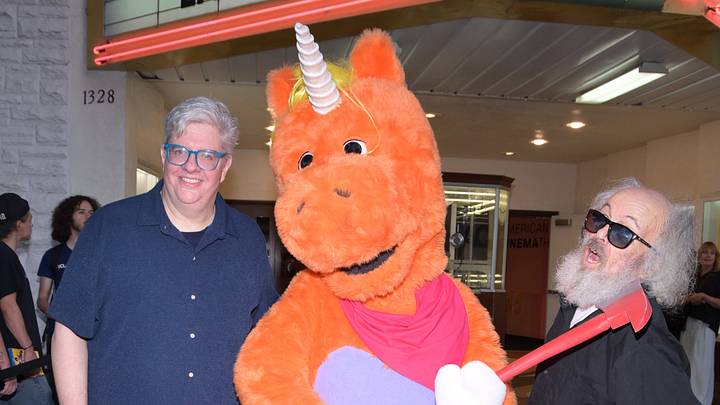
Buddy is a film about a children’s television program, “It’s Buddy!,” which stars Buddy, a citrus-colored unicorn. The “It’s Buddy!” show is a work of edutainment, similar in structure to countless real-world children’s television shows from across the years, but most notably Barney & Friends, right down to that show’s peak era of popularity: the ‘90s. The question of what exactly is “It’s Buddy!” and what is up with the off-kilter plush unicorn-suited individual at its center is what drives the film from its very opening frames, and the creation of the media-within-the-media is one of the most hypnotic and entrancing tricks that Kelly’s film pulls off.
The opening act of the film is essentially three episodes of “It’s Buddy!” played back-to-back-to-back, and it is absolutely remarkable. The first thing that must be noted is how to-the-T successful Kelly and his team are at replicating everything about this era of children’s entertainment, from the look to the pace to the tone and more; this is an impressively faithful recreation of a show that never was. Anna Kathleen’s production design is sublime; Kelly and DP Zach Kuperstein’s visual language is so deeply indebted to the cinematic grammar of these programs in such a palpable way; the music by composer Michael Yezerski pulls you that much deeper into it; and the performances are all so spot-on. The first episode of “It’s Buddy!” that the audience is shown is played entirely straight, to the extent that you could’ve told me you dusted off an old VHS and this was what was on it, and I would have believed you.
In an era full of horror films that don’t trust their audience or their collective attention span and thus resort to cheap scare tactics right out of the gate in a very streaming-oriented way of thinking, Buddy stays the course with a confidence and dedication that are deeply admirable. By allowing this opening to play out in this way, the audience is familiarized with the ebbs-and-flows of the show-within-the-movie in a way that pays off in spades over the rest of the opening and the film as a whole. By the time we get to the tail-end of the first episode and things begin to twist in nefarious directions, it is all the more impactful specifically because we can feel the structure of the thing going off-course in notable ways.
For what it’s worth, the structural consistency and tonal tightrope walk that the opening act of Buddy pulls off are so great that it could have stopped right there and been a near-perfect short film unto itself. That is not to say that the rest of the film is without its merits, as there are certainly some incredibly notable high points of genre-fueled insanity, but rather simply to point out that there is a strength and simplicity in that opening act that gets a bit diluted by the explanation and exposition that later parts of the film attempt to offer.
I love the ways in which Kelly plays with aspect ratios throughout the film, utilizing them to visually convey the differences between the various regions, such as what’s happening on the “It’s Buddy!” set and what’s happening beyond the boundaries of that show. I also really admire the sheer commitment to the atonal structure of the whole thing. Immediately after that banging opening act, Kelly’s film chucks audiences into a seemingly disconnected suburban family storyline, starring Cristin Milioti and Topher Grace, that takes its time in circling back around to revealing its connections to the prior parts of the film and tees things up for the culmination in the film’s back half.
The film manages to be scary, funny, and thoroughly entertaining in equal measure, all while also offering some keen insights into the media whose forms it is playing with. In lesser hands, it is certainly not difficult to imagine a cheap riff on “what if Barney but evil” going horribly wrong, but Kelly’s overt familiarity with such material and craftsmanship allows for much more meaningful analysis, dissection, and ultimately subversion.
Unfortunately, it does feel like the film falls a bit into the pitfall of attempting to rationalize too much of its narrative mechanics in the third act, as it attempts to explain the hows and whys of all that has occurred up until that point. I am certainly of the opinion that the film didn’t need this and would’ve been an overall stronger final product without any of this. Simply existing as this surrealist genre-fueled bit of cinematic exploration was more than enough for me, but I understand the desire to have it all make a more surface-level amount of “sense” for general audiences, so I don’t begrudge them that choice.
On the whole, I enjoyed Buddy immensely. If you are even vaguely familiar with Kelly’s immense body of work, then this is likely going to be right up your alley, as it does often play like a culmination of all of it. Also, even considering my gripes about the latter parts of the film, I can’t help but profoundly admire a 2026 horror film that has the balls to do an extended homage to Night of the Hunter in one of its most inspired visual gags. Gonzo stuff, well worth the trip to the theater.
GRADE: B-
 Add us as a preferred source on Google