

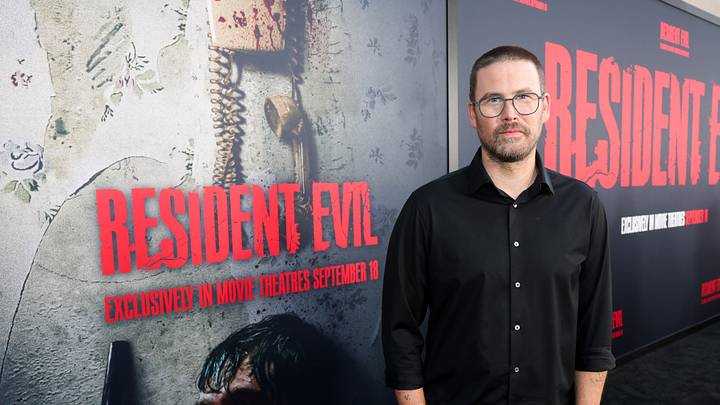
There’s something so infectiously joyous about the new Resident Evil movie.
Written, directed, and produced by Zach Cregger, who is coming hot off the heels of making the Academy Award-winning and zeitgeist-capturing Weapons, this film is the horror filmmaking equivalent of strapping the audience to a rocket and just launching it for the next ninety minutes. There’s an indulgent, uninhibited, and invariably authentic air to Cregger’s Resident Evil, and that might have been a problem if it weren’t just so exquisitely made. This is a great genre filmmaker who has truly come into his own with a sense of awareness both with regard to his own burgeoning legacy and the larger legacy of the science-fiction horror subgenre as a whole and is just riffing on the whole thing with panache to spare.
The result is one of the most nonstop entertaining pieces of cinematic spectacle you’re likely to see this year.
The story of Resident Evil revolves around Bryan (as played by now-frequent Cregger collaborator Austin Abrams), a medical courier who is tasked with the seemingly simple job of getting a medical bag from point A to point B. What he doesn’t know is that betwixt those two points is a whole cacophony of f--ked-up shit, as the T-Virus infection begins to unfold in real-time all around him. If that narrative sounds kind of scant, it’s very much by design. The film’s plot is little more than a skeletal structure upon which Cregger can hang various horror setpieces and go-for-broke gonzo filmmaking swings.
The film is hysterical and horrifying in equal measure, and a huge part of that stems from Abrams’ central performance. So much of the movie is just Abrams being tasked with reacting to some of the most insane visual imagery that Cregger has put to screen yet, and the actor knocks it out of the park time and again.
Where previous Resident Evil adaptations have always put heavy focus on how cool and capable the main characters are in taking down these infected hordes, watching Abrams’ character feels like a real dude that got plopped in the middle of this movie. The ingenuity of this approach from Cregger is that it makes the film vastly more entertaining on every front; the gags are funnier, the horror is more intense, and the action sequences ultimately feel that much more satisfying. With this movie, Cregger feels like the first person to discover that watching someone who knows all the ins-and-outs of a video game and its lore play that video game can feel insular and kind of dull. This is like watching someone who suck at Resident Evil play Resident Evil, and it’s all the more thrilling and accessible to audiences of all kinds because of it.
There was a whole discourse leading up to the release of this film that it didn’t look faithful enough to the games, which was an absurd conversation to be having at all in a world where there have already been an ungodly number of attempts at adapting these games to the screen and the majority of them have been bad. But wouldn’t you know it, once you’ve seen the actual film, it’s clear just how idiotic these concerns were all along. Cregger’s Resident Evil is steeped in deep adoration for the games in terms of tone, aesthetic, and overall feeling, as well as featuring multiple direct homages to the games themselves. It is an experiential movie, one that isolates you in this world with this character in a way that feels highly immersive, and yet it never sacrifices craft in the name of fidelity.
Film is a medium all its own, and that’s why it always induces eye-rolls from me when video game movies feel the need to shackle themselves to the strengths of the video game medium at the cost of being a good movie. Recent examples of this would include things like The Super Mario Bros. movies or even The Last of Us, all of which are projects that will copy-and-paste entire sequences from the games verbatim and lose something integral in the conversion process. Speaking as someone who has spent countless nights staying up until the wee morning hours playing Resident Evil games with friends, Cregger’s film manages to nearly perfectly capture that experience and all the ineffable joy that comes with it.
The visual language here is stunning, with Cregger and DP Dariusz Wolski crafting a palette that expands alongside the scope of the narrative (often literally, with the IMAX frame). Much of the camera movement throughout feels indebted to Sam Raimi’s work especially on a film like Evil Dead II: Dead By Dawn, with hyperactive kineticism engineered to sell the insanity of the scares and laughs as they unfold in equal measure. This is all also a testament to Joe Murphy’s editing, which does such a great job of balancing the various genre influences at play here and allowing for resonance and impact on every front.
At the end of the day, Resident Evil feels like witnessing a genre filmmaker in his prime imperial age cutting loose and making something that incites passion within him on multiple fronts. In that way, it reminded me of something like John Carpenter’s The Fog, a no-f-cks-given film that just uses its whole runtime to pursue niche interests and stunt on everyone else in the process. For as much as Cregger’s film is indebted to the games, it’s also indebted to the works that inspired them: Carpenter’s The Thing, Ridley Scott’s Alien, David Cronenberg’s The Fly, and even John McTiernan’s Die Hard. The whole thing is this ludicrous gonzo blast that is unrelentingly entertaining, and yet it always keeps its focus on theme and character above all. Nowhere is that more apparent than in the film’s final minutes, which, alongside the shocking-yet-perfect ending of Weapons, cements Cregger as a filmmaker who is completely unafraid to take big swings and leave audiences on brutal endings.
GRADE: B+
Zach Cregger’s Resident Evil rules. Whether you’ve played the games or not, this film is a gnarly good time at the movies that I think genre fans are going to eat up.
 Add us as a preferred source on Google