

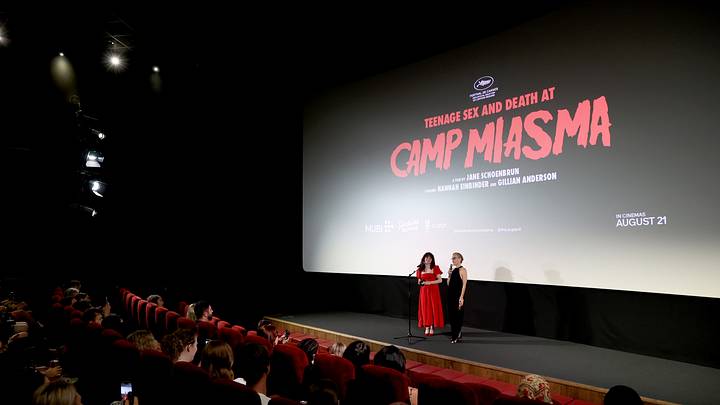
Where does the line between fantasy and fact fall? Between movies and reality? Between memories and dreams? These are the conundrums at the forefront of Jane Schoenbrun’s new film, Teenage Sex and Death at Camp Miasma, a richly textured, thrilling, and often hysterical ultra-meta camp slasher for the modern age.
For the uninitiated, Schoenbrun has long excelled at exploring the relationship between audiences and the media they consume, which ultimately consumes them. Their debut film, We’re All Going to the World’s Fair, is equal parts liminal horror and an extrapolation on the very place of such a medium within digital culture at large. Their sophomore film, I Saw the TV Glow, conjured even more explicit connective tendons between television shows, childhood, and one’s ultimate sense of self. And now, with Camp Miasma, they’ve moved to the next logical subsection of mass media: cinema itself.
Camp Miasma tells the tale of Kris Williams (as portrayed by Hannah Einbinder), a young upstart queer filmmaker whose shoestring-budget debut earned her critical acclaim and who has since been hired to write and direct a reboot of the long-running slasher franchise, “Camp Miasma.” In the process of trying to break the story for this new iteration, she journeys out to see Billy Presley (as portrayed by Gillian Anderson), the now-reclusive actress who played the ‘final girl’ in the original film. Things proceed from there, as the membrane between the diegetic and non-diegetic increasingly bleeds through, from the in-film film to the film itself and from the film to us as an audience.
If that all sounds a bit heady, well, it is by its very nature. But I also found it to be remarkably accessible and empathetic on an emotional level, as well as just obscenely entertaining. The “Camp Miasma” franchise within the narrative most directly equates to the Friday the 13th franchise of our real world, with Schoenbrun and co. making several direct homages to that series throughout the film’s artifice, craft, and themes. However, there are also clearly other elements of other slasher stalwarts sewn in, resulting in a work that is miraculously capable of having its blood-soaked cake and eating it too. Teenage Sex and Death at Camp Miasma is a ludicrously well-crafted vintage-era slasher film, full of blood, guts, flesh, and fluids, while simultaneously pulling apart the very instincts behind these grisly onscreen acts from the perspective of the filmmakers, the audience, and those trapped within the celluloid itself.
In these ways and more, desire is a huge part of the film, and yet it never feels judgemental about such things in the least. This isn’t a film that’s looking to lambast you as an audience member for enjoying the more classical slasher tropes, but rather one that looks to deconstruct them in the service of putting you as a viewer inside of them. By the film’s conclusion, you’re likely to emerge from the other side only all the more comfortable understanding and celebrating those desires.
Visually, Schoenbrun and DP Eric Yue (who previously collaborated on I Saw the TV Glow) have delivered another entrancing and tactile filmic experience. The lighting, colors, and camera movement throughout the film are happy to reference other slashers but never feel constricted by them. Instead, Schoenbrun and co. are eager to channel more classical influences, such as Powell and Pressburger. Nowhere is this more apparent than in the rich, Technicolor-esque color palettes of the film, further accentuated by some truly gobsmacking matte paintings. The editing by Graham Mason is stupendous as well, walking a similar high-wire balancing act, blending Friday-indebted transitions or under-cranks with choices that feel outright transgressive in relation to these very genre trappings.
All of this is only further accentuated by the performances at the heart of the film, which are outright palpable in their impact. Anderson is stupendous in her role, ebbing and flowing with the film’s very fluid tone in fascinating ways. Her performance builds to a culminating fireside chat beat that sees the actress taking the material and running with it to bold new heights. And Einbinder? She’s flat-out unbelievable. For my money’s worth, the film’s single most transcendent moment comes at its culmination, which features a full-frame close-up of Einbinder’s face, and it practically sears through the screen in an extremely on-theme fashion.
GRADE: A
Overall, Teenage Sex and Death at Camp Miasma is not only an incredible addition to Jane Schoenbrun’s larger body of work, but it is also a startlingly affecting film in its own right. It’s an experience unlike any other you’re likely to have at the theater this year, effectively cultivating a viewing environment for audiences that allows them to both be present and have an out-of-body moment, much like the characters in the film. I adore this movie.
 Add us as a preferred source on Google