

The ‘80s have been done to death.
Nostalgia for this single decade of pop culture has been present in some capacity for multiple decades now. I mean, J.J. Abrams, the producer of the film we’re talking about today, made a reverent love letter to the decade with Super 8 sixteen years ago. When Stranger Things released in 2016, the whole ‘80s nostalgia thing practically seemed old-hat. Now, a full decade and dozens-upon-dozens of Stranger Things-indebted ‘80s riffs later, it can feel exceedingly difficult to muster up any excitement for a film that is looking to continue beating this well-and-truly-dead horse.
But if there’s any modern genre filmmaker who has earned the right to return to the decade, it is David Robert Mitchell. The indie filmmaker infamously broke through to the mainstream in a big way back in 2015, with the release of his seminal high-concept horror film, It Follows. And while that film wasn’t set in the ‘80s, everything about the film, from its narrative construction to its visual craft to its iconic musical score by Disasterpiece, carried a strong late-‘70s/early-‘80s vibe.
In fact, I would argue that in going well beyond simply aping the base-level aesthetics of the era and instead digging into the actual substance of those films and what made them work, It Follows was a much more precise encapsulation of the strengths of the era than any number of the imitators that followed.
So while I wasn’t exactly bowed over at the concept of Mitchell’s new film, The End of Oak Street, being an ‘80s-set film, he had more than earned my interest. Fortunately, I needn’t have worried in the first place, because like It Follows before it, The End of Oak Street sees Mitchell carrying his retro influences into the very bones of the piece, resulting in a film that is light on the visual hallmarks that have come to define ‘80s nostalgia-centric films today and heavy on the actual artistic qualities that defined the era at the time.
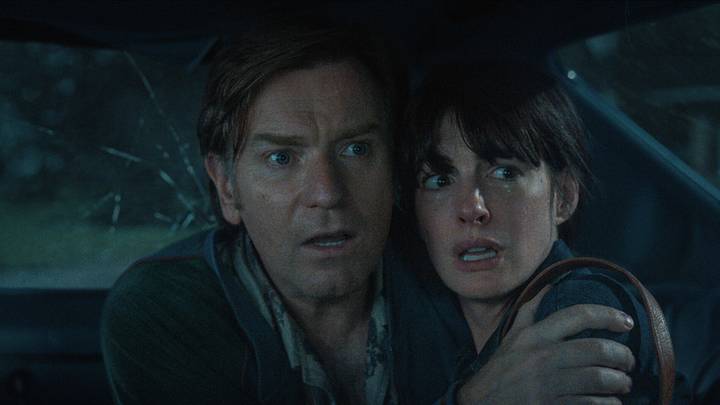
The End of Oak Street tells the story of the Platt family and their fellow neighbors on Oak Street, who come up against some insurmountable odds when their entire neighborhood is inexplicably transported back to prehistoric times. The Platt family, led by performances from Anne Hathaway and Ewan McGregor, are the exact kind of nuclear unit that so often occupies these Amblin-indebted tales: a mother and father whose marriage is on the rocks and the daughter (Maisy Stella) and son (Christian Convery) who are caught in the middle of their marital tensions. Of course, once the extraordinary circumstances arrive, bonds are tested and forged in the process of attempting to overcome unfathomable trials and tribulations.
If the overall narrative hook of it sounds familiar, it’s because it is. Mitchell has been exceedingly forthcoming about the influence of things like The Twilight Zone and classic Amblin films on his new movie, and you can see that in practically every facet of the piece. But what’s surprising is how well the film pulls it all off. You’ve likely seen more films that you can count in the past decade that feature kids riding bikes around an idyllic ‘80s suburb, but I can almost guarantee you have not seen one that pulls off the grace notes and interpersonal beats quite like The End of Oak Street does. It lends the whole production a sense of authenticity and verisimilitude that is so sorely lacking from many other such examples.
This approach in Mitchell’s writing results in a lean, mean, and unexpectedly pathos-laden film. There’s a real sense of space and resonance to the emotions at play in the film, in a manner that I was thoroughly unprepared for. First and foremost, this serves as a testament to the performers, all of whom are wonderful. McGregor has long been an under-discussed talent, and the aching quality he is able to sew into his character’s most banal of traits is fascinating. But it is, for like the fourth time this year, Hathaway who just about walks away with the whole picture.
She is nothing short of phenomenal here, bringing raw emotionality and power to her every interaction. This is especially true in the latter half of the film, as things escalate, and Hathaway is able to capitalize on many of her character’s more understated beats from earlier in the movie in truly exemplary ways. Phenomenal, grade-A stuff that really does harken back to the Spielberg films of old, in which some of the most talented performers of the age would lay it all on the line in the middle of a pulpy genre concept.
The other element at play here though, is Mitchell’s direction. So much of the film’s visual language works by tying together action and reaction into single shots, allowing the performers and their stupendous work to breathe a different kind of life into ILM’s incredible cretaceous creations. Beyond this, Mitchell just demonstrates a real deftness and articulation for the quiet moments between characters, utilizing he and DP Michael Gioulakis’ camerawork, craft, and the editing of John Axelrad in some truly sublime ways. There’s a moment early in the film in which McGregor and Convery have a father-son interaction that can’t last more than a minute and a half, but it's all captured in one take and completely recontextualizes their relationship. It reminded me of any number of smaller beats in Jaws, in the best of ways.
Another area in which Mitchell’s film really excels at truly feeling like a film of the late-‘70s/early-‘80s in a substantive way is in its skillful crafting and orchestration of suspense. It should come as no surprise to anyone who has seen It Follow that Mitchell is clearly a disciple of John Carpenter when it comes to crafting sustained sequences of suspense on film. While It Follows clearly drew inspiration from Halloween, Oak Street feels more directly indebted to Carpenter’s techniques in The Thing, in which Carpenter and co. would craft multi-pronged suspense sequences, essentially getting to shock the audience while also keeping them in suspense for elongated periods of time.
Here, Mitchell employs similar tactics and delivers some truly nerve-shredding sequences that painstakingly build out multiple threads of suspense simultaneously. Something like the albino snake sequence (you’ll know it when you see it) is straight up some of the most effectively crafted suspense I have seen in a film in years, and it reminds you exactly why Mitchell is such a treasure.
I also loved Michael Giacchino’s score here, which further fleshes out some of the influences at play in a big and broad fashion. In addition to the aforementioned pillars of inspiration, I was surprised at how much Oak Street dabbled in an early ‘60s sci-fi sensibility when it came to tone, and Giacchino leans all the way into that idea. There are moments in which the film feels like a multi-million dollar riff on something like At the Earth’s Core, and Giacchino’s sweeping score brings out those elements with a Planet of the Apes-era Jerry Goldsmith-esque score. It would have been so easy for the composer to steer into the skid and simply do a Spielberg/John Williams riff, but instead he takes an alternative route, and the film is made far richer because of it.
Overall, I was pretty blown away by The End of Oak Street. I went in hoping that it would be good but was also a bit apprehensive about the fact that Mitchell’s long-awaited return to the big screen could well be a one-for-the-books situation, in which the film simply felt like another J.J. Abrams-adjacent riff on Spielberg material. Instead, the film is delightfully off-the-wall and manages to feel so wholly Mitchell’s own. This thing is full of idiosyncratic visual decisions and distinctly off-kilter filmic choices, all of which make the experience that much more enthralling. Beyond happy to have Mitchell back in this capacity and thrilled to have a film this well-crafted and joyously inventive with the craft in theaters. Great stuff.
GRADE: B+
 Add us as a preferred source on Google