

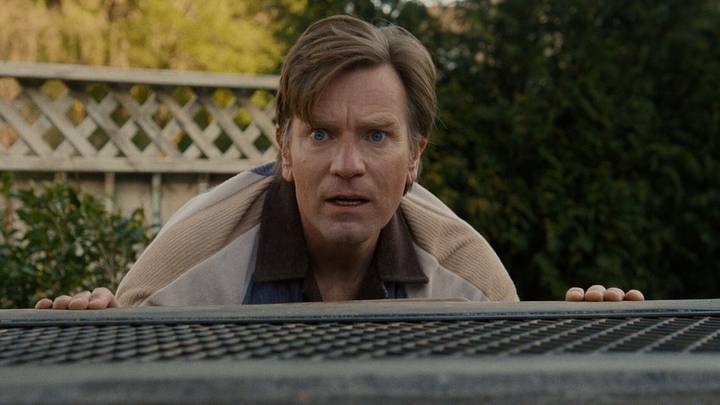
The End of Oak Street looks like a pretty awesome movie, and it’s one I personally have been incredibly jazzed about for a long time. Directed by David Robert Mitchell, starring Ewan McGregor and Anne Hathaway, it looks to be a Twilight Zone-indebted Amblin throwback about a whole neighborhood that is unexpectedly transported back to dinosaur-filled times. That checks a whole lot of boxes for me personally, which is why it’s been kind of surreal to see the marketing for the film seemingly struggling to capture audiences.
David Robert Mitchell burst onto the scene back in 2015 with the theatrical release of the original horror film, It Follows, a captivating and boundlessly compelling horror film. His follow-up film, Under the Silver Lake, was excellent but got a weirdly squandered release at the time and netted a divided response. This seemed to ice his career in unexpected ways, which sucks. Because especially in hindsight, it’s difficult to overstate just how influential It Follows was.
The film beat Stranger Things to the punch on the whole synth-scored horror throwback thing, was critical in laying the foundations for the new generation of thematically driven horror films, and was literally ripped off beat-for-beat by Smile years later. So to this end, I was immensely excited to see the director back behind the camera for a film of this size and scope and eager to see him score a much-deserved win.
But bizarrely, Warner Bros.’ marketing department has taken a last-minute punt at some truly awful marketing tactics for The End of Oak Street, partnering with an AI podcast in some truly baffling cross-promotion.
The podcast in question was the pre-existing “DogPack,” which is an entirely AI-generated podcast of dogs talking to one another. It is every bit as insipid and idiotic as that description makes it sound and feels like it was tailor-made to exist solely in the bowels of hell that are your extended family’s Facebook reels. This is all so strange, given that, by all accounts, there is no AI utilized in the actual End of Oak Street film, on any level. In fact, between Mitchell as a director and the inherently throwback nature of the hook of the film itself (dinosaurs-meets-Twilight Zone-meets-Amblin), the entire movie seems to be rooted in distinctly artisanal, handcrafted aesthetics.
The post has since been taken down, for pretty obvious reasons.
This makes the marketing choice to partner with this AI dog podcast such an insane one that is now doing far more harm than it is good to the film. AI is a highly controversial topic at the moment, especially in entertainment, with it being shoved down everyone’s throats on a near-constant basis through online platforms and ads. Just last week, Eli Roth’s Ice Cream Man was met with universal disdain, in no small part due to its use of AI-generated footage. Thus, the choice to partner with this AI podcast put End of Oak Street right in the crosshairs of this larger discourse, in an unwitting and outright stupid way.
I am still incredibly jazzed to catch The End of Oak Street this week, but it’s immensely frustrating to see David Robert Mitchell’s hard-earned return to the spotlight being actively handicapped in this way by the marketing team. Hopefully, this can serve as a lesson for other studios and future projects, though; for all the corners AI proposes to cut for your movie or marketing, it is ultimately only going to cost you so much more.
 Add us as a preferred source on Google