

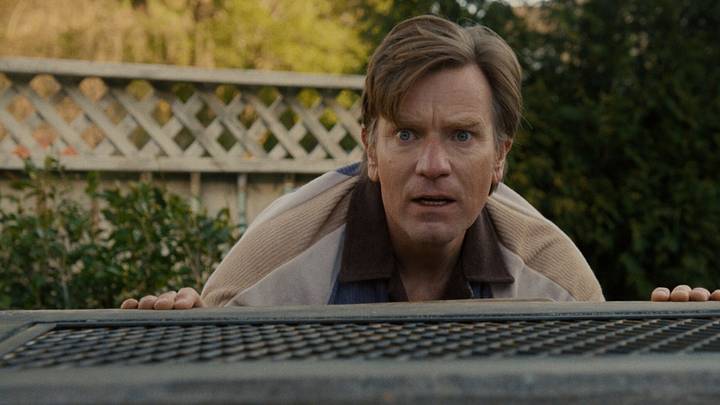
If you saw The End of Oak Street in theaters this weekend, chances are good there was a moment in the film’s second act that made your audience collectively gasp in shock. David Robert Mitchell’s throwback adventure-horror-thriller is nothing short of an absolute blast, with tons of great moments throughout. But one particular beat manages to feel shocking and invasive in a way that so few modern films are able to achieve, and I’d like to break down exactly why this moment reverberates so powerfully within the film.
Obviously, spoilers lie ahead for The End of Oak Street. If you haven’t seen it, I can’t recommend checking it out on the biggest screen possible enough. You deserve to experience this shocking beat for yourself, as it really is a joy.
The End of Oak Street revolves around the Platt family, which is comprised of a daughter and a son and is led by parents played by Ewan McGregor and Anne Hathaway. The family lives on Oak Street in 1982, and after some bright lights appear outside their windows late one night, they wake up to find that their entire neighborhood has somehow been transported back to the Cretaceous era, where all manners of prehistoric creatures abound, including a whole bunch of dinosaurs.
The first act-and-a-half of the film consists of the Platt family trying to make sense of what is happening and each having some shocking first encounters with smaller dinosaurs. However, everything comes to a head late in the second act, when the family members all find themselves coming face-to-face with the gargantuan Allosaurus on the pavement of Oak Street. This is one of the film’s most technically accomplished and visually stunning sequences, as Mitchell and DP Michael Gioulakis capture the big dinosaur’s confrontation with the family in intricate, sustained takes as they all run about, trying to distract the dino from one another.
The scene culminates in Hathaway’s character being cornered on a house’s front porch, pinned between a wall and the encroaching Allosaurus’ jaws. To save her, McGregor’s character goes running up, sledgehammer in hand, and bashes the dinosaur’s ankle. The dinosaur spins around in pain, and McGregor smashes it right in the face with the hammer, knocking the Allosaurus over, and runs up to rescue Hathaway.
Not only is this a thrilling action beat, it’s also the culmination of McGregor’s entire character arc. Throughout the film, the marital difficulties between Hathaway and McGregor’s characters become increasingly clear, as she has dreams of leaving the family behind for bigger things and feels as if he is holding her back at times with his defeated and occasionally lethargic approach to life. So McGregor’s character stepping up in this way is a huge beat, and everything from Mitchell’s camera to Michael Giacchino’s score very much plays it as such: a genuine triumph of heroics.
And then, McGregor gets promptly eaten by that very same Allosaurus.
Immediately after saving the day and fulfilling his arc, McGregor’s character is pulled off his feet, dangling in the air as the recovered Allosaurus rips his leg off, throws him down on the ground, and then devours him whole. This is a genuinely shocking moment for a number of reasons. First and foremost, there’s the way in which Mitchell stages the whole thing, which is with this morbid objectivity. It’s simply something that happens in a matter of moments and then is over, highlighted in excruciating detail by cutting to Hathaway’s horrified reaction shot.
But beyond that, every single thing in the film, textually, subtextually, and even metatextually, has been telling us that a character such as McGregor’s was not in any real life-threatening danger. The Platt family has already encountered smaller dinosaurs multiple times in the lead-up to this scene, and they have all emerged largely unscathed, so why would we think this scene will go any differently? Furthermore, the reference points that this film is drawing from, such as Poltergeist or E.T., are not exactly heavy on character deaths. Both of those Amblin films feature suburban families of the ‘80s in extreme peril but never kill off any of the main characters.
Beyond this, there’s also the Jurassic Park element to consider. While The End of Oak Street is very much its own thing, it’s difficult to see any dinosaur-related film in the modern era without thinking of the Jurassic franchise. And when was the last time a main character was killed in a Jurassic film? Never. Even dating back to Spielberg’s 1993 classic, while countless peripheral characters bite the dust, the main characters of any given film have always remained completely safe, even amidst the dinosaur-sized chaos.
Pile all of this on top of the fact that McGregor’s character’s act of heroics here is him making good on his character arc, and the second he knocks the Allosaurus over with the sledge hammer, you can’t help but cheer for him. So then, when he is unceremoniously dispatched immediately after, it feels outright upsetting on a foundational level.
The film this twist most made me think of was actually Hitchcock’s Psycho, which infamously sees its main character of Marion Crane just beginning to fulfill her own character arc when a silhouetted killer comes careening into her bathroom and gruesomely murders her in the shower. In a very similar way, The End of Oak Street sees Mitchell playing his audience like a fiddle and subverting expectations in the name of making McGregor’s character’s death all the more upsetting and impactful.
 Add us as a preferred source on Google