

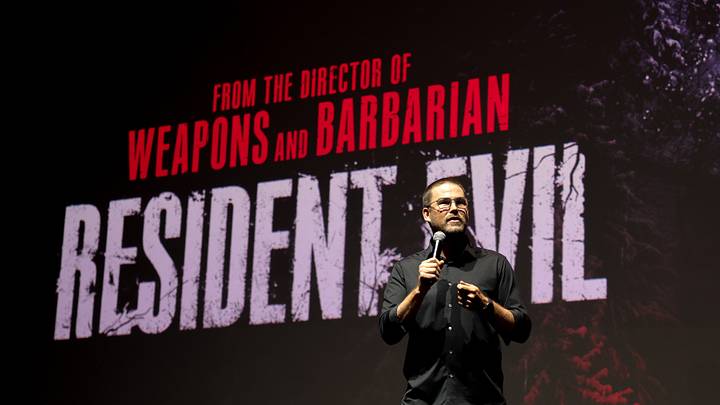
Over the years, video game movies have gotten a bum rap, and it isn’t exactly difficult to understand why that is. The vast majority of attempts to adapt a video game to the big screen have been at best disappointing and at worst outright abysmal. Through the decades, the approach to making video game adaptations has changed pretty drastically, as cultural trends evolved around them, but in many ways Zach Cregger's Resident Evil feels like a whole new kind of adaptation. And to understand what I’m talking about here, you don’t need to look much further than the mixed bag that is the collection of Resident Evil adaptations themselves.
For decades, any movies made from video games were made with little attention paid to how, what, or why they were adapting the work. We’ll lovingly refer to this as the ‘pre-fidelity era’ of adaptation, a time in which video game movies cared little about how faithful they were being to their source material, because studios and executives assumed that the vast majority of the general audience wasn’t going to be overly familiar with the subject matter anyway. You think about films like the live-action Super Mario Bros. from 1993, Lara Croft: Tomb Raider from 2001, or Prince of Persia: Sands of Time from 2010. These are films that often feel blissfully unaware of the strengths or weaknesses of the video games they’re actually adapting and instead just kind of take some portion of the core hook of the game and apply it to a movie.
Then, somewhere around the mid-2010s, there’s a seismic shift in the way these projects are being handled. Suddenly, there’s a huge surge in popularity of so-called ‘nerd culture’ as online outlets and social media platforms begin contributing to the discourse surrounding these adaptations and their overall reception in palpable ways.
This leads to an era we’ll call the ‘fidelity era,’ wherein the name-of-the-game in video game adaptations becomes being as faithful as humanly possible so as to appease the core audience, with the thought process being that doing that will ultimately prove the most beneficial to the film’s box office prospects. Examples of this would include The Super Mario Bros. Movie from 2023, Uncharted from 2022, or even HBO’s The Last of Us series. These are projects that go out of their way to fully recreate entire sequences from the games on the screen.
Of course, the hindrance of such obscene fan service and fidelity to the games is that they often fail to account for the fact that what works in one medium won’t necessarily work in another. Film is a wholly different experience than video games, and watching who knows how to play Mario play Mario isn’t particularly interesting or compelling.
Fascinatingly, the entire curvature of this trajectory over the years has been immortalized in celluloid by none other than the Resident Evil movie franchise. Paul W.S. Anderson’s first film from 2002 fell directly in the midst of the pre-fidelity era, and boy does it show. The movie is very much a disconnected action thriller that is largely not concerned with being particularly faithful to the games. This continued for the next couple of sequels, but by the time you get around to the fourth film, Resident Evil: Afterlife in 2010, Anderson is suddenly introducing characters pulled directly from the games like they’re legacy inclusions and even recreating entire action sequences from the more recent games in the movies. This trend continued through the final three films in that series and into subsequent attempts at relaunching the brand, like Welcome to Raccoon City.
This is what makes Cregger’s film so notable, though; it feels like the first video game adaptation that is truly a part of the ‘post-fidelity era.’ Cregger’s Resident Evil is imbued with a metatextual awareness of the video game it is adapting, the tropes of the games themselves, and the hurdles that prior adaptations have faced. In the narrative of the film, there are even literal references to ‘video game shit,’ with Cregger having the characters actively provide commentary on the relationship between this film and the games. In this way, Cregger’s film demonstrates an understanding that neither the pre-fidelity nor fidelity eras were able to offer; it bakes the core conceits and strengths of these games into the very fabric of its storytelling but feels totally unbeholdened to mimicking them. In this way, Cregger’s Resident Evil is able to truly do the work and retrofit this franchise for the big screen in a way that has never been done successfully before.
I sincerely hope this is the beginning of a new era for video game movies. It seems like audiences are hungry for great, truly satisfying cinematic experiences again, and movies that simply copy-and-paste cutscenes from the games into live-action aren't going to cut it. The world is ready for the post-fidelity era, and Cregger’s Resident Evil’s success proves it.
 Add us as a preferred source on Google